

AI Beneath the Surface:
What “Something Big” Means for Scuba and Underwater Exploration
Jill Heinerth
Last week, while I was speaking at Economic Outlook and Ai conferences in the Bahamas and Cayman, Robert posted an article I wrote 18 months ago. In the world of AI, that may be the dark ages. The capability of AI is growing exponentially and the time is now to learn about what it can do, not from a dated free model, but from capabilities released in the last few weeks.
In recent months, conversations around artificial intelligence, (AI) have intensified. In his viral essay “Something Big Is Happening,” Matt Shumer argues that recent AI model releases mark a real inflection point. It is no longer incremental progress, but a qualitative shift in capability. At the same time, a Forbes response, “The Problem With Tech’s Latest ‘Something Big Is Happening’ Manifesto,” cautions against overhyping technological change and glossing over limitations.
For most divers, this debate might seem distant from the realities of currents, gas planning, or deco stops. But underwater exploration (especially technical and cave diving) may be one of the environments where AI’s recent advances become quietly transformative.
From Tool to Collaborator
Historically, dive and underwater technology has evolved in clear steps: improved regulators, dive computers, rebreathers, better submersibles, sonar mapping. Each innovation enhanced safety and exploration range. AI represents a different kind of evolution. We’ll be seeing better hardware, but also smarter systems and human machine interfaces.
Recent AI models can synthesize complex datasets, reason across multiple variables, and generate analyses of complex scenarios. It’s far more than putting an avatar of your likeness on a tech diver’s body. In diving terms, this could mean systems capable of integrating historical dive incident data, real-time weather and current patterns, personal biometrics, gas consumption trends and navigation.
The shift isn’t about replacing dive judgment. It’s about enhancing preparation and execution of dives.
For tec divers and expedition teams, where risk margins are thin, AI-assisted planning tools could help identify subtle patterns that human teams might miss. They could help us choose better buddies, review research about PO2 or dive algorithms, clarify accident analysis, summarize plans for complex cave dives, and prompt us about risky behaviors. That’s where Shumer’s argument resonates: the capability jump in recent models feels materially different from what existed even a few years ago.
Mapping the Unknown
Underwater caves and deep ocean environments remain some of the least mapped places on Earth. Combining AI with photogrammetry, sonar scans, and autonomous underwater vehicles could accelerate 3D mapping, creating a “Google Ocean” of data to explore.
Instead of spending months manually stitching together cave survey data, AI systems will process imagery and spatial information at scale, helping teams generate detailed 3D cave or wreck models, optimize exploration route choices, and preserve fragile environments like wrecks through predictive analysis. Perhaps you’ll ask the model to help you choose vacation dates that will offer the best animal encounters with good visibility or avoid cave flooding, tropical cyclones or storm events that might wipe out your trip.
This isn’t speculative science fiction. The underlying AI vision and modeling capabilities already exist, and recent improvements in multimodal systems have significantly enhanced their ability to interpret both visual and contextual data.
Marine Conservation and Monitoring
For marine biologists and conservation divers, AI’s impact may be even more immediate. Image recognition systems can now identify species or coral bleaching patterns, interpret the spread of wasting disease, track fish populations, and detect invasive species far more efficiently than manual review alone. Divers still collect the footage and humans still interpret findings and make policy decisions. But AI dramatically reduces the lag between data collection and actionable insight. In that sense, AI becomes a force multiplier for conservation, not replacing divers, but amplifying their reach.
A Necessary Note of Caution
The Forbes critique is important here. AI systems remain imperfect. They can reflect biases in training data or population skews. They can misinterpret history if they don’t have data setts that include the diverse population of divers today. They cannot replace in-water situational awareness or training discipline. Underwater environments are unforgiving, so over reliance on automation is dangerous.
But acknowledging limitations doesn’t negate progress. The recent generation of AI models shows measurable improvements in contextual reasoning, long-form analysis, and cross-domain synthesis. That matters in technical fields where complexity is high and decision-making is layered.
The Future: An Analytical Dive Buddy
AI in scuba and underwater exploration is unlikely to look like robotic divers replacing humans. Instead, it will resemble a powerful analytical partner that processes massive datasets, models risk scenarios, and helps refine equipment and safety protocols.
If something big is happening, it may be more like augmentation than disruption. The recent evolution of AI has shifted it from novelty assistant to capable collaborator. For divers pushing into deeper, darker, and more complex environments, that collaboration could mean better preparation, smarter exploration, and ultimately, safer discovery.
It will assist in design.
It will enhance planning.
It will accelerate mapping and conservation work.
But, humans will still lead the dive.
Many of us first became aware of Artificial Intelligence in the form of HAL 9000 from 2001: A Space Odyssey.
The AI Future Is Here - Something Big Is Happening
From Robert McClellan
I initially equated using artificial intelligence tools like Claude or Chat GPT to the late 1980s when I was a Navy Photographer and we were working with Canon and SONY to prototype digital SLR cameras. They were clunky, the software was complicated, and the image resolution simply sucked. I dismissed this whole “Digital Photo” thing and remained firmly entrenched in the analog film camp. In hindsight, it was a huge mistake. I had the opportunity to help pioneer a paradigm-changing technology but did not give it a chance. A few decades later Eastman-Kodak stopped supporting film formats, and eventually went bankrupt. They could have owned the digital imaging space, but like me, they held on to the status quo just a bit too long. It wasn’t until I married Jill and we started creating documentary films as “Heinerth Productions” that I embraced digital video and almost understood it. These days most of us have more computing power and better cameras in our pockets than the big digital SONY rigs Jill and I shot those documentaries with.
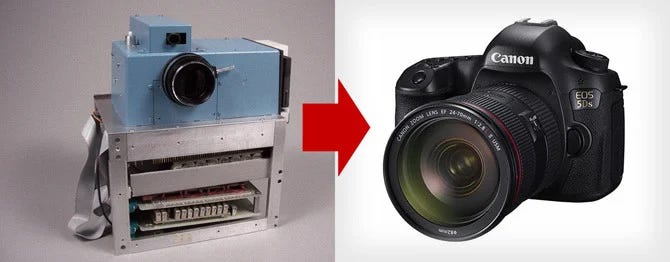
Above: (Left) The first experimental generation of digital imaging
One of the other things we carry around in our pockets is most of the known knowledge of the modern world in the form of AI apps on our smart phones. There seems to be trepidation among some people who are wary of AI’s powerful capabilities. Fair enough. There are some AI behaviors that have justified caution. One of the most common fears is that “AI will replace me and my job.” Again, fair enough. There are thousands upon thousands of people who have already been displaced by AI in the work force. And there will be millions upon millions who will lose their jobs to artificial intelligence in the near future. And that future is now!
I want to share a remarkable article by Matt Shumer, an AI expert. Here’s a bit about him copied from his blog:
I’m Matt Shumer — founder & CEO at OthersideAI (HyperWrite). I build and invest in AI products, ship fast, and share what I learn with a large audience.
Lately: pushing GPT‑5 to its limits, collaborating on AutoRL with OpenPipe (acquired by CoreWeave), and helping early teams go from zero → launch.
Mr. Shumer’s article is getting a lot of attention in the business, political, economic, and technology worlds. I even heard a UK talk radio host discuss it with call-in listeners for an hour the other night. (When I should have been sleeping).
Somewhat ironically, Jill was presenting at an AI conference in Cayman when I read this article. (See her essay above). I forwarded it to her. Many of the big guns of AI were already buzzing about it and she was embedded amongst them for days.
Another short excerpt from Shumer’s article:
“I Know This Is Real Because It Happened To Me First”
“Here’s the thing nobody outside of tech quite understands yet: the reason so many people in the industry are sounding the alarm right now is because this already happened to us. We’re not making predictions. We’re telling you what already occurred in our own jobs, and warning you that you’re next.”
You know the old saying “Knowledge is Power”? Well, I don’t want to make the same mistake as I did back in the early dawn of digital photography. I am learning as much as possible about AI apps and how to APPLY THEM AS TOOLS in my professional and personal endeavors. (As we create this newsletter we do not use any AI tools other tha spell check to write it. All the hallucinations are ours alone, thank you).
Here’s a link to Matt Shumer’s article on his blog. If you work a white collar job or manage people or projects, or if like me consider yourself among the Creative Class, it should be mandatory reading. SOMETHING BIG IS HAPPENING.
Thankfully, there are some things that AI can never replace: Human empathy, kindness and love. We should all strive to “Stay Human” as the world around us transitions to a more digital and superficial environment. Take a moment this week and consciously LOVE ONE ANOTHER.
I have to say that I have been very weary of AI and while most of the stuff goes way over my head, I am starting to understand some of the benefits and that is thanks to you guys! Technologic advances are happening at such rapid speed, weather we like it or not! Might as well try to understand it and see how it can actually enhance our lives! Knowledge truly is power! Great newsletter.